
Most car accidents stem from momentary lapses in judgment. Perhaps a driver glances at a phone, misjudges a gap in traffic, or brakes too late. Falling cargo accidents are different.
When a log rolls off a timber truck on Route 119, or a coil of steel comes loose on the interstate, it’s rarely just an “accident” in the truest sense of the word. It is almost always a failure of process that happened hours before the truck ever left the shipping yard. Such an accident implies that someone may have cut corners on loading, failed to check the tension on a strap, or ignored a frayed chain to save money.
Despite this, the trucking company certainly doesn’t want you to see it this way. Their defense teams frequently argue that the object on the road was debris from an unknown source, rather than a failure of their securement system. They do this to shift the narrative from negligence to bad luck.
This is likely not bad luck. With a little digging, we find that these accidents often result from a violation of federal and state safety protocols.
At Marcus & Mack, we handle the investigation into these failures. We look past the driver to identify every party in the chain of custody, such as the logistics company that sealed the trailer and the fleet manager who ignored maintenance logs. If you were injured by unsecured cargo in Pennsylvania, we will help you determine who is responsible and how you can secure compensation.
In a standard fender-bender, you sue the other driver. In a falling cargo case, the driver is typically just the first domino in a line of liable parties.
The first layer of responsibility lies with the operator. Under federal law, specifically 49 CFR § 392.9, a commercial driver must inspect their cargo within the first 50 miles of a trip and re-inspect it every 3 hours or 150 miles thereafter.
If the driver fails to log these inspections, or if they check a box saying the load is secure when the straps are clearly worn, they are negligent. However, drivers are frequently judgment-proof, meaning they do not have the personal assets to cover the cost of a severe injury or a totaled vehicle.
To secure proper compensation, we typically look to the trucking company (the carrier). Under the legal doctrine of respondeat superior, an employer is liable for the actions of their employees performed within the scope of their employment.
If a trucking company pressured a driver to skip a safety check to meet a tight deadline, or if they failed to train the driver on how to secure specific types of loads, the company is directly liable. This allows us to access the carrier’s commercial insurance policies, which are significantly larger than personal auto policies.
This is where these cases become legally nuanced. Sometimes, a driver picks up a trailer that was pre-loaded and sealed by a third-party shipper. The driver is legally prohibited from breaking the seal to check the load.
If the cargo shifts inside the trailer and causes the truck to rollover, or if the doors burst open and cargo spills out, the driver may not be at fault. The liability shifts to the warehouse, logistics company, or distribution center that loaded the trailer. We must obtain the Bill of Lading to identify who actually placed the cargo in the truck.
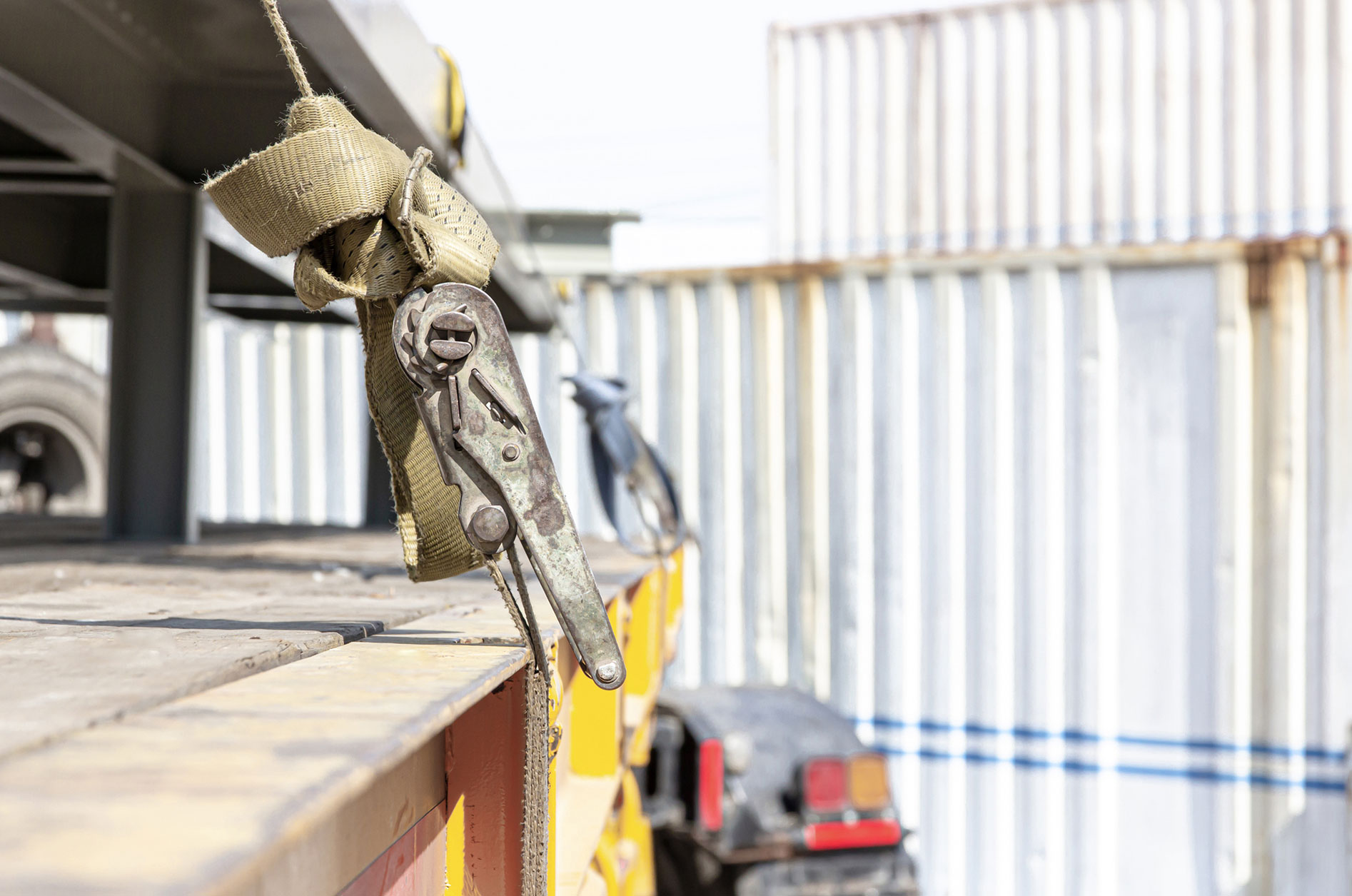
Occasionally, the drivers and loaders do everything right, but the equipment fails. If a ratchet strap snaps under normal tension, or a chain link shatters due to a metallurgical defect, the manufacturer of that securement device may be liable under product liability laws.
There are laws governing how cargo must be tied down, and we use these regulations to establish negligence per se. This is a legal concept where violating any of the following safety statutes automatically qualifies as negligence for your civil claim.
The Federal Motor Carrier Safety Regulations (FMCSR 49 CFR Part 393) dictate exactly how strong the securement system must be. The securement system must be capable of withstanding specific forces:
If a coil of steel rolls off a flatbed while the truck is turning a corner, it is mathematically probable that the securement devices were not rated for 0.5 g of lateral force, or they were applied incorrectly. Physics effectively proves the negligence.
Different types of cargo have their own Rules of the Road. In Western Pennsylvania, we frequently encounter specific violations related to our local industries:
You might wonder if these federal laws apply to a local logging truck that never leaves Indiana County. The answer is generally yes. 67 Pa. Code Chapter 231 adopts the federal standards for intrastate commerce.
This means a local hauler is held to roughly the same high standard as a long-haul interstate trucking company. They cannot plead ignorance of federal safety standards just because they operate locally.
One of the most frustrating scenarios for our clients is the miss-and-run. A truck hits a bump, a piece of scrap metal flies out of the bed, and the driver continues down the highway, completely unaware they have just caused an accident.
You are left with a damaged vehicle, injuries, and an empty road ahead.
In many areas of law, you must prove exactly what the defendant did wrong. In falling cargo cases, we sometimes argue res ipsa loquitur. This Latin phrase means “the thing speaks for itself.”
Washing machines do not fall off trucks if reasonable care is used, period. Thus, the mere presence of the cargo on the highway implies negligence. This allows us to proceed with a claim even if we cannot pinpoint the exact moment the driver failed to check the strap, provided we can identify the truck.
Identifying a phantom truck requires immediate investigation. We look for:
If the truck cannot be identified, you are not necessarily out of options. In Pennsylvania, you may be able to turn to your own insurance policy under Uninsured Motorist (UM) coverage.
There are specific evidentiary hurdles here. Pennsylvania law typically requires the accident to be reported to the police and the insurer promptly. While phantom vehicle cases typically require physical contact to prevent fraud, falling cargo cases are unique because the contact is with the cargo, not the truck itself. We help you present the necessary corroborating evidence to your insurer to validate the claim.
In the days following an accident, the evidence you need is in danger of disappearing. The trucking company will want to repair the truck and put it back in service. They may throw away the broken ratchet strap or delete the driver’s digital logs.
This is why we act quickly to send a spoliation letter.
A spoliation letter is a formal legal notice demanding that the trucking company preserve specific evidence. If they destroy the evidence after receiving this letter, the court may sanction them or instruct a jury to assume the destroyed evidence would have shown they were at fault.

The most telling piece of evidence is the driver’s Driver Vehicle Inspection Report (DVIR). If a driver marked the cargo securement as “satisfactory” at 8:00 AM, and the load fell off at 8:30 AM, it suggests one of two things: either the driver falsified the log without actually looking, or they were incompetent in their inspection.
We compare these logs with the physical reality of the accident to find discrepancies.
Modern commercial trucks are equipped with Electronic Control Modules (ECMs) and telematics systems. These systems record data points like harsh braking, sudden swerving, and speed.
We will overlay this data with the location of the accident. If the data shows the truck swerved violently right before the cargo fell, that swerve may be the proximate cause of the securement failure. It proves that the driver’s handling of the vehicle contributed to the load coming loose.
If you or a towing company preserved the object that hit you, it becomes a piece of evidence. A forensic examination of a broken strap can reveal if it was cut by a sharp edge (improper edge protection) or if it snapped due to age and UV degradation.
If the strap was old and frayed, the trucking company had constructive notice of the danger—meaning they should have known it was unsafe to use.
Our practice focuses on the specific risks found in Western Pennsylvania. The topography and economy of Indiana County create a unique environment for falling cargo accidents.
We share the road with industries that transport difficult-to-secure materials:
Physics dictates that a truck driving on a winding Pennsylvania state road experiences different forces than a truck on a straight interstate. The winding roads in our region increase lateral (sideways) g-forces.
If a trucking company secures a load based on the assumption of straight highway driving, but routes the driver through the winding hills of Western PA, the securement may fail. We look at the route planning as a potential source of negligence.
Many dump trucks display signs saying “Stay Back 200 Feet” or “Not Responsible for Broken Windshields.” These signs are intimidation tactics with no legal standing, as a trucking company cannot sign away their liability for negligence. If they failed to tarp the load or clean the loose rocks off the bumper, they are responsible for the damage, regardless of the sign.
These are known as no-contact accidents. You may still recover damages, but the burden of proof is higher. You will need to prove that your reaction was reasonable and that the debris on the road was the cause. Independent witnesses are very helpful in these scenarios to verify that the debris existed.
Under 42 Pa. C.S. § 5524, the statute of limitations for personal injury and property damage torts is generally two years. However, waiting this long is ill-advised because evidence (like the driver’s logs) may be legally destroyed by the trucking company after six months in some cases.
Yes. If the truck was sealed and the driver could not inspect the load, the liability falls on the shipper or logistics company that loaded it. We frequently bring claims against these third parties.
In many cases, yes. Your Uninsured Motorist (UM) coverage may apply if we can prove the accident was caused by a phantom vehicle. We will review your policy to see what coverage is available to you.
You should not be forced to dip into your savings or pay for a new car because a logistics company decided to rush a shipment or save money on equipment.
The law provides a path to hold carriers, shippers, and drivers accountable, but the evidence required to prove these claims is volatile. It requires swift preservation of logs, data, and physical debris.
At Marcus & Mack, we know how to secure this evidence before it disappears. Call us today for a free consultation. We will move immediately to investigate the chain of custody and build your case, ensuring you are positioned to recover the maximum compensation available.
Marcus & Mack