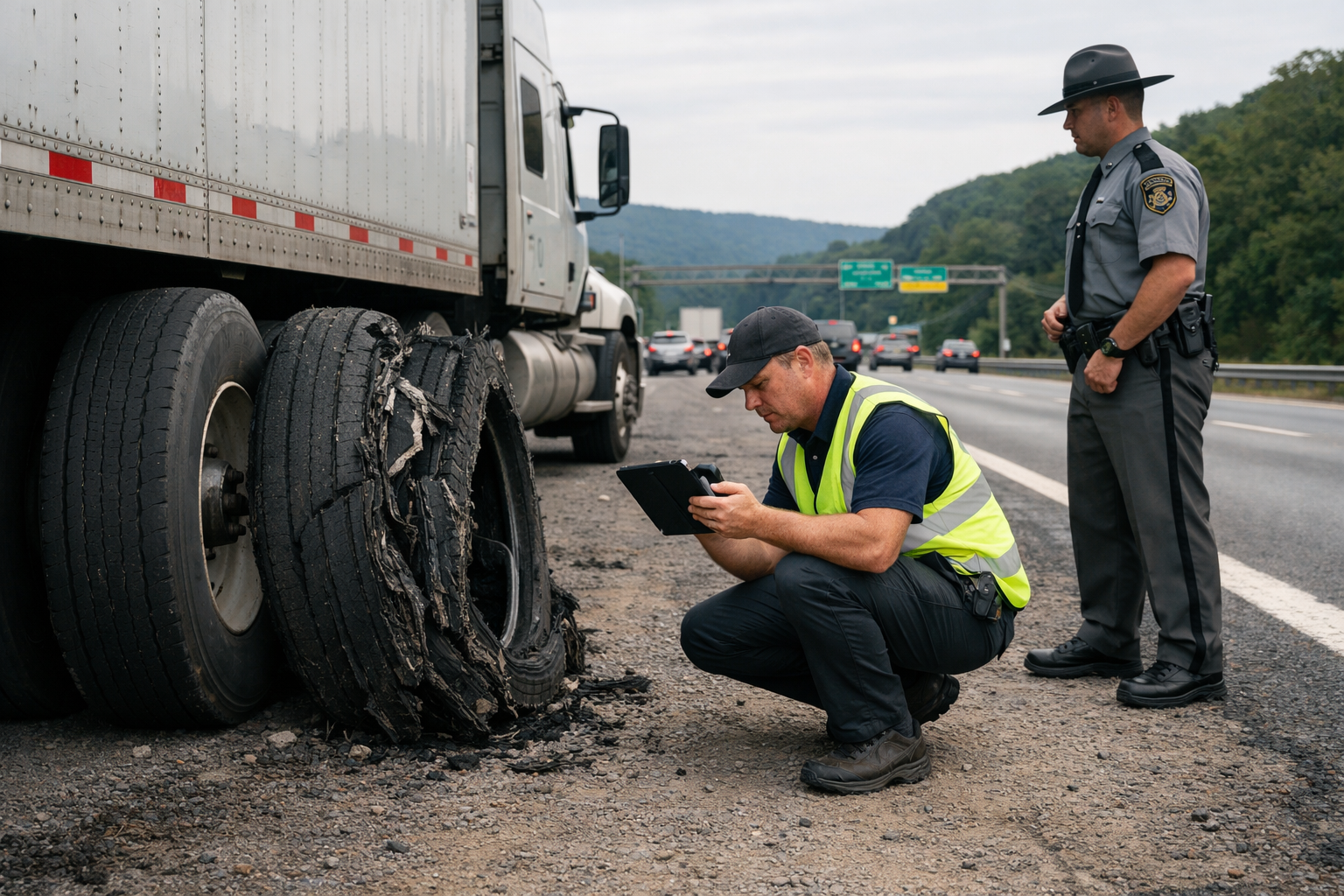
The sight of a large commercial truck can be intimidating on any Pennsylvania road. When one of its tires fails, the results can be catastrophic, leading to serious accidents that change lives in an instant. If you or someone you love has been hurt in a crash like this, you are likely facing a difficult recovery and a mountain of questions. One of the most urgent questions is, “Who is responsible?”
When a tire failure on a massive truck leads to a collision, the answer is often more complex than it first appears. A truck accident caused by a defective tire may involve several different parties who could be held accountable for the harm you have suffered.
The responsibility could lie with the company that made the tire, the trucking company that failed to maintain it, a mechanic who serviced it improperly, or even the truck’s driver. Uncovering the truth requires a careful investigation into the tire’s history and the moments leading up to the crash.
Commercial truck tires are engineered to withstand incredible forces. They carry immense weight for thousands of miles, often across challenging terrain and through varying weather conditions, from the summer heat on Route 22 to the icy winters along I-80. However, even the most robust tire can fail. These failures generally fall into two main categories: problems with the tire itself or issues related to its use and maintenance.
A tire might have a manufacturing defect, which is a flaw that was present from the moment it left the factory. This could be an error in the design, the use of substandard materials, or a mistake during the assembly process that makes the tire unsafe. A common example is tread separation, where the outer layer of the tire peels away from its core.
The other primary cause is related to maintenance and wear. Because trucking is a business with tight deadlines, sometimes essential safety checks can be overlooked.
Distinguishing between a manufacturing flaw and a maintenance issue is critical, as it points the investigation toward different potentially responsible parties.
When a truck accident caused by a defective tire occurs, determining legal responsibility—or liability—is a detailed process. It involves looking at every entity that had a hand in the tire’s journey from the factory to the highway. More than one party could share the blame, and a thorough investigation will explore the role each of them played.
If the accident was caused by a flaw in the tire itself, the manufacturer could be held accountable under a legal concept known as product liability. This principle holds that companies that design, manufacture, and sell products have a duty to ensure those products are safe for public use. If a defective product causes harm, the company can be held responsible.
There are three main types of defects that can lead to a product liability claim:
The chain of distribution, which includes the manufacturer, distributor, and retailer, could all be part of a product liability claim.
Trucking companies, also known as motor carriers, have a significant legal duty to keep their vehicles in safe working order. This isn’t just a good practice; it’s the law. The Federal Motor Carrier Safety Administration (FMCSA) sets strict rules for vehicle maintenance. For example, 49 CFR § 396.3 requires motor carriers to systematically inspect, repair, and maintain all of their commercial vehicles.
A trucking company can be found negligent if it fails to uphold this duty. Negligence is a legal term that means failing to use reasonable care to prevent harm to others. This could include:
In these situations, the company’s failure to prioritize safety directly contributes to the dangerous conditions that cause a crash.
Many trucking companies outsource their vehicle maintenance to third-party repair shops. If one of these shops worked on the truck’s tires, they also take on a duty to perform that work correctly and safely. A maintenance provider could be held responsible for a truck accident caused by a defective tire if they:
These maintenance facilities have their own standards of care to uphold, and their carelessness can have devastating consequences for others on the road.
While drivers are often at the mercy of the equipment they are given, they also have their own set of responsibilities. Federal regulations require drivers to conduct pre-trip inspections of their vehicles, which explicitly includes checking the tires for any visible defects or inflation issues.
If a driver notices a tire is low on air, has a visible bulge, or shows excessive wear but decides to drive the truck anyway, they could be considered negligent. Their failure to act on a known danger could make them partially responsible for the resulting accident.
Proving why a tire failed and who is responsible is a complex, technical process. It is not something you should have to figure out on your own while trying to recover from serious injuries. The process requires a swift and methodical investigation to secure evidence before it is lost or destroyed. A successful investigation often involves several key steps.
This kind of detailed investigation, whether it focuses on a trucking terminal near DuBois or a repair shop in Altoona, is fundamental to building a strong case and holding the right parties accountable.
If you were injured in an accident that was not your fault, you have the right to seek compensation for your losses. In legal terms, these losses are called “damages.” The goal of seeking damages is not to punish anyone, but to provide you with the financial resources necessary to cover the costs of the accident and help you rebuild your life. The specific compensation available depends on the details of your case, but it generally falls into a few categories.
Every person’s recovery journey is different, and the compensation you may be entitled to should reflect the unique challenges and losses you have faced.
Here are answers to some common questions that arise after a truck accident involving a failed tire.
This is a common defense. While road debris can damage a tire, a properly maintained and manufactured commercial tire should be able to withstand normal road conditions. An expert analysis can often determine if the tire failed because of a pre-existing defect or weakness that was made worse by a road hazard, which could still point to liability on the part of the manufacturer or maintenance provider.
Pennsylvania has a law known as the statute of limitations, which sets a time limit for filing a personal injury lawsuit. Generally, you have two years from the date of the injury to file a claim. It is very important to act within this timeframe, as waiting too long can prevent you from ever being able to seek compensation.
A “retread” is a reconditioned tire. While retreads are legal and can be safe when done correctly, the retreading process can sometimes be faulty. If a defective retread tire fails, the company that performed the retreading process could be held liable in addition to the trucking company that chose to use it.
Yes. Pennsylvania law allows for liability to be shared among multiple at-fault parties. For example, a jury might find that a tire manufacturer was 60% responsible for a defective product and a trucking company was 40% responsible for failing to notice the defect during inspections. A legal team can help identify all potential sources of liability to ensure you can seek full compensation for your losses.
It is often best to be cautious when dealing with an early settlement offer from an insurance company. Their goal is typically to resolve the claim as quickly and inexpensively as possible. An initial offer may not account for the full extent of your future medical needs or long-term lost income. It is wise to understand the full scope of your damages before accepting any settlement.
A truck accident caused by a defective tire creates complex legal challenges that require a deep understanding of both state and federal law. You do not have to face this difficult situation alone. At Marcus & Mack, we are committed to helping injured people in our communities, from Indiana and Johnstown to State College and beyond, stand up for their rights. Our attorneys have the experience and resources to conduct the thorough investigation these cases demand.
We know you are going through a trying time, and we are here to provide the support you need. We handle all personal injury cases on a contingency fee basis, which means you pay no attorney fees unless we recover financial compensation for you. Let us focus on the legal details so you can focus on what matters most: your health and your family.
Don’t wait to get the help you deserve. Contact Marcus & Mack today to schedule a free, no-obligation consultation to discuss your case. We are available 24/7 to listen to your story and explain how we can help.
Marcus & Mack